
By Laura Scotcher on behalf of SLH
On Saturday I walked through Heaton Mersey Common with my daughter ( a great place to spot all kinds of birds) and to her delight we spotted a Grey Heron (Ardea cinerea) standing in the pond near Berwick Avenue.
I consulted several articles to write this post (linked below) and invariably they start with describing the distinctive physical characteristics of the heron. Their long legs, bill and neck; grey backs and white necks; and the thin black eyestripe connected to the long black feathers that spike out from the head and lead down the neck. These practical, physical descriptions are often interwoven with anthropomorphic words such as elegant, majestic, patient and bewitching. The common thread running through this is that the heron is an unmistakable and instantly recognisable bird.
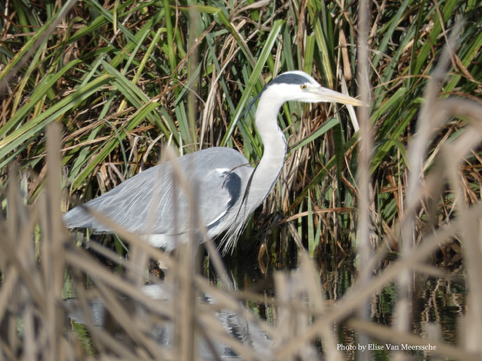
Photo by Elise Van Meerssche
Where do Herons live and where and can I spot a Heron in the Heatons?
Herons are typically found near water e.g. rivers such as the Mersey and ponds such as the one in Heaton Mersey Common. They can be spotted either standing in water, on a riverbank or, perched up high in a tree branch. I have very occasionally seen a heron perched on a neighbouring rooftop, keeping an eye on my garden pond. You may also see heron’s in flight and they form a recognisable silhouette against the sky with their legs stretched out behind them and their neck pulled in.
However, despite being instantly recognisable and unmistakable, they are surprisingly easy to miss if your attention is elsewhere! This is due to their habit of standing incredibly still either waiting to dart and spear their pray or after recent meal. Herons prey on relatively heavy animals and will stand still for several hours while they digest their food.
What’s on a Heron’s menu?
Mostly water dwelling creatures such as fish and frogs. They will also eat small birds such as ducklings and small mammals such as voles. When I spotted a heron in my garden it was keeping an eye out for frogs!
Photo by Laura Scotcher
What do Heron’s sound like?
Herons are iconically silent and stealthy. When they do call out it sounds like a harsh ‘kraank’ call or a “kronking” bark. The Royal Society for Protection of Birds (RSPB) and British Trust for Ornithology (BTO) webpages include bird song and call recordings. Links below.
Where do Herons nest?
Herons gather in large groups to nest from March to May. The groups collect in treetop sites called heronries and return year after year. Some heronries have been occupied for many decades and these have been monitored in the UK since 1928 through the Heronries Census.
Want to learn more?
I gathered the information for this article from the following sources…
https://www.countryfile.com/wildlife/birds/heron-facts
https://www.rspb.org.uk/birds-and-wildlife/grey-heron
https://www.wildlifetrusts.org/wildlife-explorer/birds/herons-egrets-spoonbill-and-crane/grey-heron
https://www.wildlifetrusts.org/visit/where-see-wildlife/where-see-spring-wildlife/where-see-heronry
https://www.wildlondon.org.uk/wildlife-explorer/birds/herons-egrets-spoonbill-and-crane/grey-heron